

Understanding Binary Search in Data Structures
📚 Explore binary search in data structures: efficient searching in sorted lists, how it works, variations, pros, cons, and real-world applications explained.
Edited By
Emily Blake
Binary trees form a core concept within data structures in computer science. At its simplest, a binary tree is a hierarchical structure where each node has at most two children, often called the left and right child. This allows efficient organisation and quick access to data, which is essential in various software and computing tasks.
Unlike linear data formats like arrays or linked lists, binary trees represent data in a way that reflects relationships and ordering. This makes them particularly useful for sorting, searching, and maintaining ranked information.
Key point: Binary trees help structure data so that operations such as insertion, deletion, and lookup can be performed quickly, often in logarithmic time.
In Pakistan's fast-evolving financial sector, handling large datasets comes with daily challenges. Binary trees are behind many algorithms used in financial software for managing portfolios, real-time market data analysis, and risk evaluation. For example, binary search trees can speed up finding a specific stock price among thousands, aiding quicker decision-making.
Understanding binary trees begins with these components:
Node: An individual element holding data, like a stock symbol or price.
Root: The top node from which all others branch.
Leaves: Nodes without children, representing end points.
Edges: Connections between nodes.
By correctly organising data into nodes connected by edges, binary trees model hierarchical relationships naturally.
Binary trees appear in diverse applications:
Expression parsing: Evaluating financial formulas with operators arranged in a tree.
Priority queues: Managing trade orders where priority matters.
Decision trees: Supporting automated trading algorithms by modelling decisions.
For Pakistani software developers, mastering binary trees unlocks better handling of complex data, whether building mobile apps for Daraz or analytics for the Pakistan Stock Exchange.
Having a solid grasp of binary trees lays the foundation for more advanced structures like heaps and balanced trees, which we will explore later.
Understanding binary trees is fundamental for anyone involved in software development or data-heavy applications. These data structures streamline how data is organised and accessed, making operations like searching, inserting, and deleting data much faster. Imagine handling a large database of stock transactions on the Pakistan Stock Exchange (PSX). Using binary trees, the system can quickly locate, update, or analyse records without wasting time scanning the entire list.
Binary trees also play a significant role in financial algorithms, like those used in trading platforms or crypto wallets, where maintaining data order and fast retrieval is essential. Grasping their structure helps professionals optimise code for performance, something highly valuable in Karachi’s fast-paced tech sector.
A binary tree is a hierarchical data structure where each element, called a node, has at most two child nodes. These child nodes are commonly known as the left and right children. The very top node is called the root, forming the entry point to the entire structure. This simple setup allows data to be organised in a way that resembles a family tree or a branching road map.
In practice, binary trees are often used to store sorted data or expressions. For example, when searching for a particular company’s stock price in an app, a binary tree can help the app jump straight to the data point instead of scanning every entry.
Unlike linear data structures such as arrays and linked lists, binary trees provide a more flexible and efficient way to manage sorted data. Arrays require shifting elements when inserting or deleting data, slowing down operations. Linked lists allow easy insertion but searching can take longer since elements must be checked one by one.
Binary trees strike a balance by enabling quicker search, insertion, and deletion through a branching approach. This reduces the number of steps needed to find data, leading to better performance in applications like financial databases or real-time trading systems.

The basic building blocks of a binary tree are nodes. Each node holds data—such as a stock symbol or transaction amount—and pointers to its child nodes. The root node stands at the top and acts as the starting point. Edges are the connections between nodes, linking parents to their children.
Leaves are nodes with no children, marking the end of a branch. In the context of a financial application, leaves might represent the most specific entries, like individual stock trades or user transactions.
Binary trees follow certain rules: each node can hold up to two children, never more. This constraint keeps the structure manageable and ensures efficient navigation. Moreover, the height of the tree—the longest path from root to a leaf—affects how quickly operations run. A well-balanced tree minimises height, improving speed.
For instance, if a tree storing currency exchange rates is skewed heavily to one side, searches become slower, resembling a linked list rather than a tree. Hence, maintaining these properties is crucial for optimal performance.
Clear understanding of these characteristics helps developers build efficient data systems, crucial for Pakistan's rapidly growing digital economy and tech startups where data speed matters.
Each binary tree node contains:
Data
Pointer to left child
Pointer to right child
Root node is the topmost node
Leaves have no children
Edges connect nodes
By mastering these basics, you set a strong foundation for more advanced topics like binary tree traversal and applications in financial computing.
Binary trees come in several variations, each suited for specific tasks and performance needs. Understanding the differences among these types helps in choosing and implementing the right structure for real-world applications, including financial data analysis and crypto portfolio management. Let’s examine the main categories and their relevance.
A full binary tree is one where every node has either zero or two children; no node has a single child. For example, a tree representing decision points in a trading algorithm might be full to maintain balanced choices at each step. A complete binary tree, meanwhile, fills every level fully except possibly the last, which is filled left to right without gaps. This structure suits heap implementations often used for prioritising tasks or transactions quickly.
The practical significance lies in storage and efficiency: complete binary trees can be easily stored in arrays without wasted space, making reading and writing data faster. In Pakistan’s fintech apps, such trees may help manage transaction queues or priority scheduling with minimal overhead.
A perfect binary tree is a type of full binary tree where all leaves are at the same level, ensuring absolute balance. Meanwhile, a balanced binary tree allows some flexibility in leaf depths but maintains height differences within a limit to avoid skew.
This distinction matters because perfectly balanced trees guarantee minimal height, reducing search and insertion times. Balanced trees like AVL or Red-Black trees strike a practical trade-off by self-adjusting after operations to keep performance predictable. For instance, stock brokers’ software handling thousands of clients’ data benefits from balanced trees to keep queries snappy even when data changes constantly.
Balanced trees support efficient algorithms by limiting the worst-case complexity. They ensure that lookups, insertions, and deletions don't degrade from O(log n) to O(n), which is vital in time-sensitive financial decisions.
Skewed trees lean entirely to the left or right, resembling a linked list more than a tree. A left skewed tree has every node with only a left child, and a right skewed tree only right children. This often happens with sorted data inserted in order without balancing.
The performance impact is significant. Skewed trees lose the advantage of binary search trees because operations degrade to linear time, slowing down data lookups and updates. For crypto traders or investors dealing with live data feeds, this lag can mean missed opportunities or delayed analysis.
Avoid skewed trees in financial software by using balanced trees or tree rebalancing techniques to maintain speed and reliability.
Understanding these types equips financial analysts and tech developers with the tools to architect data structures that ensure quick, reliable access and processing — key in today’s fast-moving markets.
Storing binary trees efficiently is key for their practical use in financial modelling software, trading platforms, or crypto wallet algorithms. Proper implementation impacts the speed of operations like insert, delete, and search, which are fundamental when dealing with large datasets such as stock prices or portfolio holdings. Two common ways to implement binary trees are through nodes and pointers, or using arrays for specific tree types.
Structure of a tree node: A binary tree node typically consists of three parts — the data it holds, and pointers to its left and right child nodes. For example, in a crypto wallet app, each node might store details about a transaction, while the pointers link to related transactions. This structure allows dynamic growth; nodes can be added or removed easily without reallocating entire blocks of memory.
How nodes link together: Nodes connect through their pointers, forming the tree structure. The root node points to its children, which in turn point to their own children, and so on. This linked nature means you can represent complex hierarchical data like market order books or company shareholding structures naturally. It also allows easy traversal and manipulation, crucial for real-time updates common in stock trading systems.
Using arrays for complete binary trees: Complete binary trees, where all levels except possibly the last are fully filled, lend themselves well to array storage. Instead of using pointers, elements are stored in contiguous array positions. This approach fits well with heaps, often used in priority queues or efficient sorting algorithms in financial data processing.
Index calculation and storage benefits: Arrays ease child-parent navigation using simple formulas: for a node at index i, its left child is at 2i + 1, right child at 2i + 2, and parent at (i - 1) / 2. This index-based access avoids pointer overhead and improves cache performance, speeding up operations. For example, in a mobile trading app built in Karachi or Lahore, using arrays reduces memory fragmentation on lower-end devices, resulting in smoother user experience.
For developers working on investment platforms or crypto exchanges, choosing the right storage method for binary trees can significantly enhance both performance and resource management.
In summary, linked nodes offer flexibility and dynamic resizing ideal for unordered or changing datasets, while arrays work best with complete binary trees where memory efficiency and speedy access are priorities. Understanding these choices helps software teams build more responsive and reliable financial technologies.
Traversing and searching are fundamental operations in working with binary trees. Traversal methods define how we visit each node in the tree, while searching techniques help locate specific values efficiently. For traders, investors, or analysts working with datasets stored in binary trees, these operations enable quick data retrieval and systematic processing.
Inorder, preorder, and postorder traversal are the three primary depth-first traversal approaches. Inorder traversal visits nodes starting with the left child, then the parent, and finally the right child; this sequence is particularly useful when dealing with binary search trees as it returns nodes in ascending order. For example, if a stock price history is stored in a binary search tree, inorder traversal gives a sorted list of prices.
Preorder traversal visits the parent node before its children, which suits cases where you need to copy or replicate the tree structure, such as backing up portfolio data. Postorder traversal, on the other hand, processes child nodes before their parent, which is handy for deleting a tree or evaluating expressions stored in the nodes.
Breadth-first traversal (level order) differs by visiting nodes level by level, starting from the root and moving down. This approach is practical for applications that need an overview of tree structure at each depth, such as visualising hierarchical data in financial models or algorithmic strategies where processes at the same depth need to be handled together. In level order traversal, all immediate child nodes of a node are visited before going deeper.
Linear search in generic binary trees simply involves visiting each node until the desired value is found or the tree ends. This method applies when the tree doesn't maintain a sorted structure, so direct search techniques like binary search aren't possible. It’s less efficient but necessary for unstructured or partially structured data.
In contrast, binary search tree search methods leverage the sorted nature of certain binary trees. Starting at the root, the search moves left or right depending on whether the target value is less or greater than the current node’s value, drastically reducing search times. For example, a trader looking up transaction records by timestamp stored as a binary search tree can locate entries in logarithmic time, saving valuable processing efforts.
Efficient traversal and search techniques optimise data handling, which is vital for rapid decision-making in trading and investment scenarios.
By understanding and applying these traversal and search methods, you can efficiently organise and retrieve data from binary trees, enhancing performance in various computing tasks relevant to the financial sector and beyond.
Binary trees play a central role in computing by organising data in efficient, manageable ways. Their hierarchical structure allows quick search, insertion, and deletion operations, which are critical in software performance. Understanding their practical use helps traders and analysts appreciate the technology behind many applications they rely on daily.
Binary search trees (BSTs) offer fast lookup by maintaining an ordered structure. Each node contains data such that values smaller than the node are in the left subtree, and larger values are in the right. This makes searching for any element considerably faster than scanning a list because the search can eliminate half the data at every step. In financial software dealing with large amounts of stock prices or cryptocurrency values, BSTs allow near-instant search and retrieval, improving the responsiveness of trading platforms.
Priority queues and heaps, closely related to binary trees, manage tasks and data according to priority rather than order of arrival. Heaps are a special kind of binary tree where the parent node has higher priority than its children. This makes them ideal for scheduling and managing queues, such as task execution or processing transactions. For traders, this is useful when platforms need to prioritise orders based on urgency or value, ensuring that critical trades execute promptly without unnecessary delay.
In mobile apps popular in Pakistan, such as JazzCash or Easypaisa, organising user data efficiently is vital. Binary trees help these apps manage accounts, transaction histories, and customer preferences. For example, when a user searches past transactions, a BST enables quick filtering and retrieval, even on modest devices. This contributes to smoother user experience despite limited mobile internet quality.
Pakistani e-commerce platforms, like Daraz or local bazaars moving online, benefit from binary trees in their search functions. When a customer searches for products, balanced binary trees support rapid narrowing of options by price range, ratings, or categories. This reduces the wait time and enhances satisfaction, particularly during busy seasons like Eid sales where user queries surge significantly.
Efficient data organisation using binary trees is foundational for modern apps and platforms, supporting billions of daily operations across Pakistan's growing digital economy.
Binary search trees speed up lookup by splitting searches logically.
Heaps manage priorities in task and order processing.
Mobile apps use binary trees to handle large user datasets smoothly.
E-commerce search relies on binary trees for quicker filtering and product discovery.
Understanding these applications clarifies why binary trees remain a core data structure in software development, directly impacting day-to-day financial and trading activities in Pakistan.
📚 Explore binary search in data structures: efficient searching in sorted lists, how it works, variations, pros, cons, and real-world applications explained.

Explore strictly binary trees 🌳 where each node has zero or two children. Understand their key features, operations, and uses in software and academics across Pakistan.
Explore complete binary trees 📚, their unique traits, differences from other trees, practical uses in algorithms, and implementation steps for students & pros.
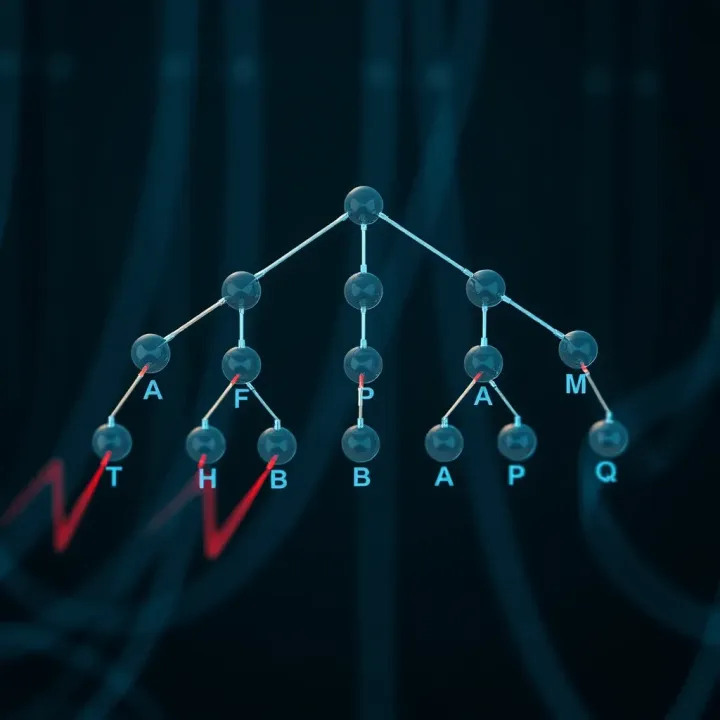
Explore binary trees in computer science 🌳: structures, types, traversal methods & real-world uses. Essential for students, developers & pros in programming.
Based on 13 reviews