

Understanding Full Binary Trees and Their Applications
Explore full binary trees, where each node has zero or two children 🧩. Learn their structure, counting methods, and real-world applications in Pakistani tech and programming.
Edited By
Charlotte Price
Complete binary trees stand out in the world of data structures because of their unique shape and efficient use in various computer algorithms. Unlike full or perfect binary trees, a complete binary tree is filled level by level from left to right, except possibly the last level, which itself is filled leftwards without any gaps. This structure ensures that the tree stays balanced, promoting efficient operations like insertion and deletion.
To put it simply, imagine organising your files on a shelf that you fill row by row, left to right, ensuring no empty space in between—this is how a complete binary tree arranges nodes. This clear arrangement allows for easier memory management, especially in systems where static or dynamic arrays are used to represent the tree.
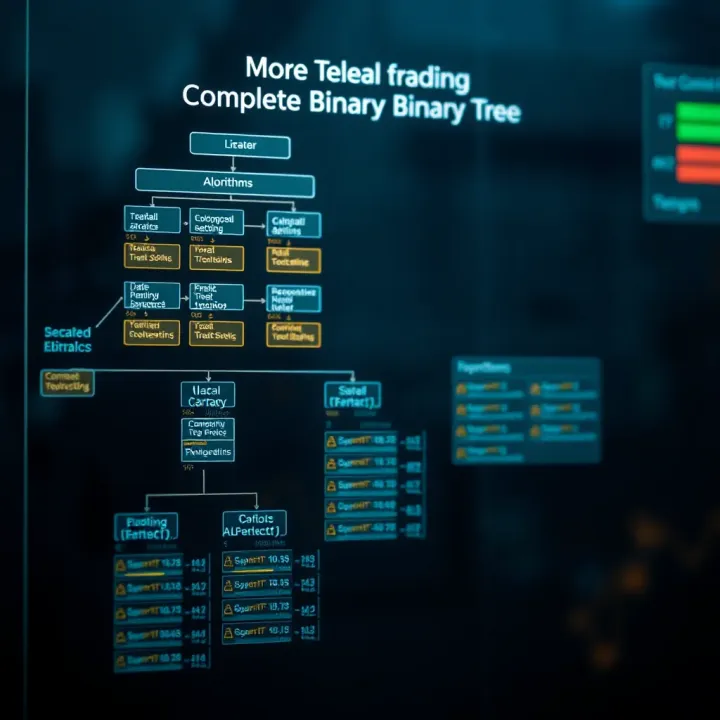
Shape: All levels except the last are completely filled.
Last Level: Filled from left to right without gaps.
Balance: Maintains a near-perfect balance, which is vital for algorithm performance.
Understanding this structure is crucial for traders and analysts who deal with large datasets requiring quick searching, sorting, or prioritisation functions. For example, heap trees, which underpin priority queue implementations, are a special case of complete binary trees. These heaps help in efficiently managing tasks like order matching or real-time price updates.
In terms of implementation, complete binary trees are generally stored in arrays without gaps, making access to parent and child nodes a matter of simple arithmetic calculations rather than complex pointers.
A practical use of complete binary trees is in constructing binary heaps, widely used in stock trading algorithms to maintain dynamically changing lists of bids and asks. When a new bid arrives, the heap structure ensures the highest priority bid is quickly accessible, allowing for rapid trade execution.
In short, the complete binary tree's design is both elegant and practical, providing a foundation for many crucial operations in finance-related software and data processing systems in Pakistan and beyond.
Understanding what makes a binary tree "complete" is important for financial analysts and traders who deal with data structures supporting efficient algorithms. A complete binary tree is a special form of binary tree where every level, except possibly the last, is fully filled with nodes. Moreover, the nodes in the last level are filled from left to right without gaps. This structure ensures balanced node distribution, which helps keep data operations like insertion, deletion, and searching both fast and predictable.
Nodes Distribution and Levels
In a complete binary tree, nodes populate the tree level by level, starting from the root (level 0) and moving downwards. Each level is fully occupied before the next one begins, except the last level, which fills from left to right. For instance, if you imagine a tree with 10 nodes, the first three levels would be completely filled, and the tenth node would sit somewhere on the fourth level, positioned as far left as possible. This strict pattern keeps the tree shallow, limiting height growth and thereby improving access times.
Difference from Other Binary Trees
Unlike full or perfect binary trees where every node has either zero or two children, a complete binary tree tolerates some incomplete nodes, but only on the lowest level and always to the right. This makes it less rigid than perfect binary trees but more structured than arbitrary binary trees where nodes might be sparsely distributed. This difference matters in real-world applications such as heaps or priority queues where the completeness guarantees efficient use of memory and predictable run times.
Illustrative Diagrams of Complete Binary Trees
Visual aids play a key role in grasping the concept of complete binary trees. Diagrams depict levels stacked neatly, with nodes aligned left, helping to quickly identify if a tree qualifies as complete. Such visual clarity assists developers and analysts to verify completeness before applying algorithms, avoiding costly errors in data handling.
Examples from Real-World Scenarios
Consider a financial trading platform that uses heaps to prioritise orders or price feeds. The underlying data structure is often a complete binary tree, because it keeps insertions fast and maintains balance. Similarly, blockchain applications, dealing with large data sets and complex sorting, leverage complete binary trees to handle tasks efficiently. These examples highlight how understanding tree structure helps optimise real-time systems in finance and crypto technology.
A complete binary tree’s clear node pattern limits delays during data processing, making it a reliable backbone for many financial algorithms requiring speed and precision.
Nodes fill level by level from left to right
Last level may be incomplete but must have nodes aligned on left
More flexible than perfect trees, more balanced than arbitrary ones
This defined structure enables developers to build faster data retrieval methods and maintain efficient memory usage, essential for handling large volumes of financial data.
Complete binary trees have defining properties that set them apart and make them valuable, especially in data structures and algorithm design. One of the main advantages is how these properties guarantee efficiency – both in terms of space and processing time. These trees ensure quick access and insertion while maintaining a neat, balanced structure.
Understanding the height and levels of a complete binary tree helps explain its efficiency. The tree's height is the number of layers it has from the root at level 1 down to the last level. With nodes filled from top to bottom, each level contains twice as many nodes as the previous one, except possibly the last. For example, a complete binary tree of height 3 can have up to 7 nodes (1 + 2 + 4).
This relationship matters because many tree operations depend on height. Since the tree is compact and levels mostly full, height approximately equals log₂(n), where n is the total number of nodes. This ensures that search or insertion operations happen in logarithmic time, making the structure efficient for tasks requiring fast data access.
The position of nodes further affects how complete a tree is recognised. To maintain completeness, every level except possibly the last must be entirely filled, and nodes on the last level need to be as far left as possible. A node missing before others at the same level breaks this rule, signalling an incomplete tree.
This exact node placement is crucial when implementing heaps, where maintaining completeness allows operations like insertions or deletions to be generally simple and predictable.

Complete binary trees follow a strict left to right filling order on each level. Imagine filling seats in a theatre row-by-row, left to right; this helps keep nodes as densely packed as possible. This left to right approach ensures no gaps appear in nodes' placement prior to reaching the last level.
For practical purposes, this filling method simplifies indexing in array-based tree implementations. Each node's position relates directly to its parent and children, so calculating their indices, especially in heaps, becomes straightforward.
The way nodes fill levels also influences tree balance. By filling levels entirely before moving down, the tree avoids lopsidedness common in other binary trees. This balance helps keep operations like searching, insertion, and deletion efficient because the maximum depth stays close to the minimum possible.
A balanced structure ensures that worst-case operation times remain low, which is key for performance-sensitive applications like priority queues or real-time trading systems.
Complete binary trees hold a special place in computer science due to their balance and efficient structure, making them ideal for various practical applications. This section sheds light on two main areas where these trees shine: heap data structures and efficient searching and sorting algorithms.
A common use of complete binary trees is in implementing heaps, particularly min-heaps and max-heaps. In a min-heap, the smallest element resides at the root, ensuring quick access for operations like finding the minimum value. Conversely, a max-heap places the largest element at the root. Thanks to the complete binary tree structure, heaps maintain balance, which guarantees that their height is minimal and operations such as insertion or deletion remain efficient, typically in logarithmic time.
Consider a financial trading system where priority management of orders is key. A max-heap can immediately provide the highest bid price, facilitating fast decision-making. The completeness of the binary tree ensures that the data structure doesn’t degrade into a skewed tree, avoiding performance hits.
Using heaps in priority queues is another practical example. Priority queues require not just FIFO handling but prioritisation, making complete binary trees well-suited. Elements with higher priority are accessed and removed quickly, which is vital in systems processing large volumes of data, such as stock exchanges or crypto trading platforms where transaction priority impacts execution and costs.
Complete binary trees assist in binary heap sort, a sorting technique that relies heavily on the heap structure. By converting an unsorted array into a max-heap, the largest elements can be repeatedly extracted to produce a sorted sequence. This method benefits from the properties of complete binary trees, ensuring that the heap remains balanced and operations are efficient.
For example, sorting large datasets, such as financial records or trade logs, using heap sort can be faster and more space-efficient than many other algorithms. Since complete binary trees guarantee a compact shape, memory usage remains predictable.
Beyond sorting, their relevance extends into algorithm design where balanced tree structures reduce worst-case scenarios in searching and insertion. Algorithms that incorporate complete binary trees avoid the pitfalls faced by unbalanced trees, like long chains of nodes, which slows down operations and increases resource consumption.
In algorithm design for automated trading or risk assessment tools, this efficiency translates into faster processing and lower latency, critical for real-time analysis.
The practical strength of complete binary trees lies in their ability to maintain balance, providing fast, reliable operations crucial for high-stakes environments such as finance and cryptocurrency trading.
Heaps rely on the complete binary tree structure for balanced and quick access to minimum or maximum values.
Priority queues powered by heaps enable efficient prioritisation of transactions or tasks.
Binary heap sort utilises complete binary trees for efficient sorting with predictable memory usage.
Algorithms benefit from balanced trees by improving speed and reducing worst-case delays.
Understanding these applications helps traders and analysts appreciate the underlying data structures that enable fast, efficient decision-making in financial technologies and crypto markets.
Constructing and traversing a complete binary tree effectively is significant for ensuring that the tree maintains its structural properties and supports efficient operations. For traders and financial analysts working with algorithmic systems or data structures, mastering these techniques impacts performance directly, especially in priority queues or binary heaps.
Sequential insertion involves adding nodes level by level, from left to right, preserving the tree's completeness. Practically, this means when a new node appears, it's placed at the first available spot on the lowest level before moving down further. For example, when building a min-heap for managing trade order priorities, inserting new orders follows this sequence to keep the heap structure intact.
This approach helps maintain the balance and efficiency expected of complete binary trees. Using an array representation of the tree facilitates such insertions by using indices to directly calculate parent and child relationships, offering fast access and modifications.
One frequent mistake is inserting nodes without checking the next available position, which breaks completeness, leading to an unbalanced tree and inefficiencies in data retrieval. For instance, inserting nodes in a random order can create gaps at intermediate levels, complicating traversal and increasing operation times.
Another pitfall is neglecting reheapification (percolating up or down in heaps) after insertion. Without this, tree properties like the heap order get violated, affecting search or extraction operations critical for real-time decision-making in trading platforms.
Level-order traversal visits nodes level by level, left to right, matching the natural structure of complete binary trees. This technique uses a queue data structure and efficiently reflects the tree's shape, making it easy to process or display nodes in the order they appear.
In practical scenarios such as updating stock portfolio trees or managing live priority queues, level-order traversal allows rapid and systematic processing, which suits the dynamic nature of financial data. It also aids in serialising the tree structure for storage or transmission.
While less common for complete trees, these depth-first traversal methods remain useful depending on context. Pre-order traversal (root, left, right) helps in quickly copying or previewing tree data. In-order (left, root, right) is valuable when the tree represents sorted data—though complete binary trees do not guarantee sorted order, so application is limited.
Post-order (left, right, root) is beneficial for deleting trees or evaluating expressions stored in binary trees. Financial analysts handling expression trees in algorithmic trading can make use of these traversals for evaluation or debugging purposes.
Understanding these construction and traversal strategies elevates your control over complete binary trees, opening doors for optimised algorithms and smoother data management in financial systems.
Understanding how complete binary trees compare with similar tree types like full and perfect binary trees helps clarify their specific advantages and appropriate use cases. This distinction is important for traders and analysts dealing with data structures in algorithmic trading systems or financial models, as it influences speed and memory usage.
A complete binary tree fills every level fully except possibly the last, which is filled from left to right without gaps. In contrast, a full binary tree requires that every node has either zero or two children—no node can have only one child. This difference affects how data is organised, especially during insertion or deletion operations in dynamic data environments like stock exchange feeds.
For example, in a complete binary tree, the last level might not be fully occupied but is dense from the left side. Meanwhile, a full binary tree enforces a stricter shape, potentially limiting flexibility but simplifying certain algorithmic checks.
Complete binary trees are widely used in heap implementations, which power priority queues essential in real-time trading algorithms. Their left-to-right filling ensures balanced height with minimal space, leading to efficient storage. On the other hand, full binary trees are often applied in situations demanding guaranteed node degrees, like expression trees in compilers, which can be relevant in financial software parsing complex mathematical formulas.
Both complete and perfect binary trees are tightly packed structures. However, a perfect binary tree is one where all interior nodes have two children and all leaves are at the same depth. This creates a completely balanced tree with the maximum number of nodes for its height. Complete binary trees are less strict: the last level need not be fully filled, but nodes must be as left as possible.
In practice, perfect binary trees offer optimal balance but are hard to maintain under dynamic scenarios like continuously updating order books or streaming financial data, where complete binary trees provide a good compromise between balance and flexibility.
Algorithms on perfect binary trees often benefit from predictable performance due to strict balance, crucial for complex calculations or simulations used by financial analysts. Complete binary trees, while slightly less uniform, still provide nearly optimal search, insertion, and deletion times.
For example, implementing a heap using a complete binary tree allows maintaining operations in logarithmic time, which is vital for high-frequency trading systems where milliseconds matter. In contrast, enforcing a perfect binary structure would require expensive rebalancing, impractical for such fast-changing data.
Recognising these subtle differences in tree structures helps optimise data handling in financial software, ensuring a good blend of speed, memory efficiency, and maintainability.
Complete Binary Tree:
Levels fully filled except possibly last
Last level filled left to right
Used in heaps, priority queues
Full Binary Tree:
Each node zero or two children
Used in expression trees, parsers
Perfect Binary Tree:
Completely filled all levels
Highly balanced
Optimises predictable algorithm efficiency
Choosing the correct tree depends on your application requirements—whether it's flexibility for real-time updates or strict balance for predictable performance.
Explore full binary trees, where each node has zero or two children 🧩. Learn their structure, counting methods, and real-world applications in Pakistani tech and programming.

Explore binary numbers 🔢: their structure, counting basics, computing role, conversions, arithmetic, and tech uses crucial for digital electronics and IT.

Explore binary operations in math 🔢! Understand definitions, types, and practical uses in algebra, CS, & logic. Clear guide for curious minds.

🔢 Explore binary operations: types, properties, and real-world uses in math and computer science. Perfect for learners seeking practical insights! 📊💻
Based on 11 reviews