

Understanding Binary Multiplication Basics
🔢 Learn how binary multiplication works with clear examples and methods. A must-read for anyone interested in computer science and digital electronics in Pakistan.
Edited By
Daniel Morgan
Binary trees form the backbone of many programming algorithms and data structures. In computer science, a binary tree is a hierarchical structure where each node has at most two children, commonly called left and right child. This simple yet powerful setup simplifies organizing data for fast searching, insertion, and deletion.
Understanding binary trees is vital particularly for traders and financial analysts who often deal with large datasets requiring quick access and manipulation, like order books or historical price data. Crypto enthusiasts and stockbrokers also benefit when they grasp how these structures optimise querying and storing valuations and transactions.
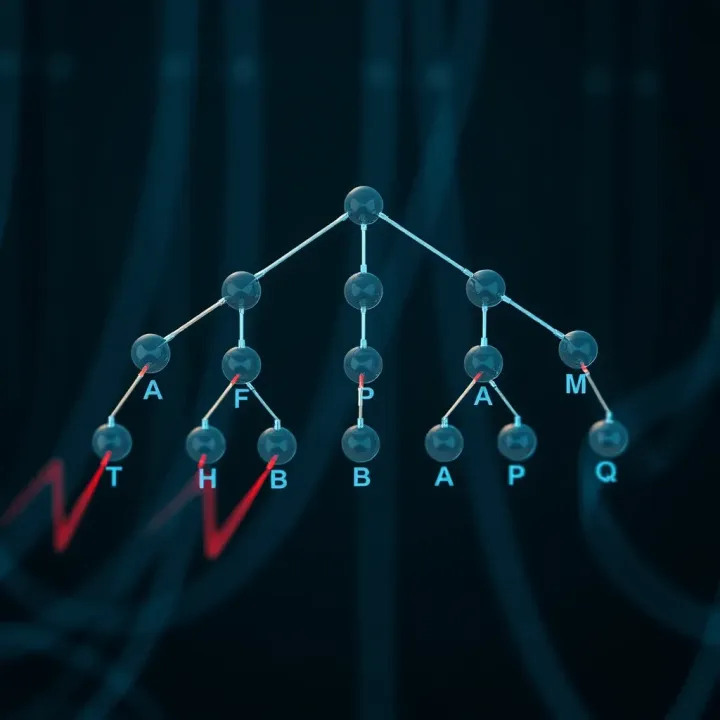
At its core, the binary tree helps breakdown complex problems into smaller units. Each node can itself act like a root for its subtrees, allowing operations to run recursively. This feature makes algorithms efficient in both processing time and memory use.
A binary tree typically supports traversal methods such as inorder, preorder, and postorder — ways to visit each node systematically. These techniques matter when extracting or analyzing data in a particular sequence, such as sorting prices or analysing trade signals.
In practical terms, binary trees power applications beyond mere data storage. For example:
Search Trees: Enhanced trees like Binary Search Trees (BST) enable quick searches, crucial for trading platforms that need to retrieve quotes instantly.
Expression Evaluation: Calculators and parsers use binary trees to evaluate complex mathematical expressions common in financial models.
Priority Queues: Binary heaps, a kind of binary tree, manage priorities efficiently, useful in scheduling and transaction processing.
This introduction sets the stage for exploring different binary tree types, their specific uses, and traversal methods that traders and developers can apply to manage financial data effectively. Understanding these will give you an edge when designing or analysing systems reliant on fast, reliable data handling.
Binary trees form the backbone of many efficient algorithms used in computer science today. Understanding their structure helps in optimising data retrieval and storage, which directly benefits traders, investors, and financial analysts who rely on fast, reliable data processing. For instance, a balanced binary search tree can drastically speed up queries on large datasets such as stock prices or cryptocurrency values.
A binary tree is a hierarchical data structure where each node has at most two children, commonly referred to as the left and right child. This simple rule allows binary trees to maintain order and create pathways that make searching and sorting swift and logical. For example, organising market data in a binary tree structure can assist a crypto trader in quickly identifying price trends.
Each element in a binary tree is a node, containing data and links to its children nodes. The topmost node is called the root; from here, data branches out to the left and right children, which may themselves become parent nodes to other children. This arrangement mimics real-world systems, like the hierarchical structure of a company's departments or folders in a computer’s file system.
Binary trees are crucial for organising data efficiently so that access, insertion, and deletion operations can be performed quickly. In financial systems, for instance, a binary tree can be used to index transactions or client records, ensuring rapid retrieval without scanning entire databases. This organisation reduces computing time and optimises server load, key for real-time trading platforms.
Binary search trees (BSTs) are a special kind of binary tree designed for fast searching. BSTs maintain sorted data, allowing operations like search, insert, and delete to generally work in O(log n) time. This makes them ideal for sorting price feeds or executing algorithmic trading strategies where milliseconds can impact profits.
Efficient data handling using binary trees helps reduce overhead and supports real-time decision-making, essential in volatile markets.
By structuring data as binary trees, programmers build systems that cope with growing data volumes without compromising speed, giving professionals in trading and investing an edge.
Binary trees come in various forms, each catering to different needs in programming and data management. Understanding these types helps in choosing the right structure for efficient data storage and retrieval. In trading algorithms or financial data analysis, selecting the most suitable binary tree can speed up decision-making and reduce computational costs.
A full binary tree is one where every node has either zero or two children. No node in this tree has only one child. This strict structure supports simple implementation and easy traversal.
In financial modelling, full binary trees find use in representing decision processes where each choice splits into two clear alternatives, such as buy/sell decisions or risk assessments. Their predictable shape also aids in compiling balanced search structures.
A complete binary tree is filled at all levels except possibly the last, where nodes are as far left as possible. This arrangement avoids gaps, making it a good choice for heap data structures.

In practical terms, trading software often uses complete binary trees for priority queues, such as arranging orders by priority or time. Maintaining a complete form ensures efficient storage in arrays, saving memory while preserving quick access.
A perfect binary tree is a full binary tree where all leaves are at the same depth. This uniform height leads to optimal balance, making operations predictable and fast.
The advantage here is clear in scenarios like balanced data indexing, where equal access time to all records benefits real-time stock data processing. The perfect tree avoids the pitfalls of uneven growth that slow down searches.
Unlike other trees, a perfect binary tree is strictly balanced and complete, offering consistent performance metrics. It rarely appears in natural datasets but is useful in controlled environments where performance guarantees are necessary.
Balanced binary trees maintain their height close to the minimal possible, ensuring that the difference in depths of left and right subtrees for any node is limited, often by one. This balance keeps search, insert, and delete operations efficient.
Skewed binary trees, by contrast, lean heavily to one side—either left or right—acting more like linked lists. This skew reduces their efficiency significantly.
For financial data processing, balanced trees support swift queries and updates, crucial when handling fluctuating market data. Skewed trees can cause delays and performance degradation, so algorithms typically include balancing steps to prevent skew.
In essence, balanced binary trees help maintain system responsiveness under heavy data loads, whereas skewed trees can become bottlenecks that traders and analysts need to avoid.
Understanding these types equips developers and analysts to choose the right binary tree to manage financial and cryptocurrency data effectively. This, in turn, impacts algorithm speed and resource use, enabling more agile and reliable trading systems.
Traversing binary trees is fundamental when working with this data structure because it provides systematic ways to visit every node. Each traversal method follows a specific sequence, affecting how the tree's data gets processed. The choice of traversal can influence how efficiently you perform tasks such as sorting, searching, or expression evaluation—key for developers and analysts working on algorithms.
Method and sequence: In-order traversal processes the left subtree first, then visits the root node, and finally moves to the right subtree. This left-root-right sequence ensures that nodes are visited in ascending order if the binary tree follows binary search tree properties. The method is simple but powerful, providing a natural way to access sorted data without extra steps.
Common use cases: In-order traversal is commonly used in scenarios that demand sorted output, such as retrieving entries from a binary search tree for reporting or data analysis tasks. For example, if a trader maintains a binary search tree of stock prices, an in-order traversal lets them review prices in increasing order effortlessly.
Process explained: Pre-order traversal visits the root first, then recursively visits the left and right subtrees. The sequence goes root-left-right. This means you'll process the parent node before moving to its descendants, useful when building or cloning the tree structure.
Applications: Pre-order traversal suits tasks where you need to copy or save the structure of a tree because the root always gets handled before any child nodes. For instance, financial analysts may use pre-order traversal when exporting hierarchical investment portfolios, preserving their exact structure.
How it works: Post-order traversal leaves the root node for last, processing the left subtree, then the right subtree, and finally the root. The sequence left-right-root ensures child nodes are handled before the parent, making it ideal for operations needing cleanup or evaluation after dependencies are resolved.
When to use: This traversal is effective in expression trees, often used in calculators or parsers, where operands get processed before operators. Crypto enthusiasts working with expression parsing might find post-order traversal useful when evaluating or simplifying complex algorithms.
Breadth-first approach: Unlike other traversals, level-order visits nodes level by level, starting from the root and moving down each depth of the tree. This breadth-first method uses a queue to track nodes, ensuring all nodes on the same level get processed before moving deeper.
Practical examples: Level-order traversal is valuable in scenarios like network routing or priority scheduling where the order of processing matters by level or hierarchy. In financial systems, it can be used to retrieve account hierarchies or access control lists quickly, reflecting real-world organisational structures.
Traversal methods shape how binary trees provide useful outputs. Selecting the right traversal can enhance algorithm efficiency and data clarity, especially in fields like trading and data analysis where performance and accuracy are non-negotiable.
Binary trees play a significant role in various practical applications, especially within computing where efficient data processing is critical. Their structured nature allows programmers to organise information hierarchically, making searches, insertions, and deletions more straightforward compared to other data structures.
Binary search trees (BSTs) are the backbone of efficient searching in many software systems. They store data in a sorted manner, where each node’s left child contains values less than the node, and the right child holds greater values. This structure allows quick lookups, often cutting down search time from a linear scan to logarithmic time. For example, searching for a specific stock price entry or a crypto transaction ID in a large dataset becomes faster using a BST.
Efficiency benefits arise because BSTs keep operations like search, insertion, and deletion generally efficient, provided the tree remains balanced. A balanced BST ensures that no side of the tree is overly crowded, preventing long chains that slow down performance. Financial applications that require rapid data retrieval, like real-time trading platforms, often depend on these trees to manage and process streaming data swiftly.
Syntax trees represent expressions in a way that mirrors the structure of programming or mathematical statements. Each node in a syntax tree stands for an operator or operand, which helps compilers or interpreters understand the order of operations. For instance, when evaluating an investment formula or a trading algorithm expression, this tree structure clarifies how different parts relate.
Evaluation of expressions benefits greatly from this place of organisation. Traversing a syntax tree lets software evaluate complex expressions step-by-step, ensuring correct calculations. This method is essential in financial modelling tools where accurate and efficient computation of expressions involving multiple factors determines trading decisions.
Index structures in databases depend heavily on binary trees to speed up query responses. B-trees and variations of binary trees help manage large datasets, such as a broker’s transaction records, allowing quick access even when millions of entries exist. These indexes reduce search times significantly, leading to faster data retrieval.
Hierarchical data organisation is another area where binary trees excel. File systems often store directories and files in a tree-like fashion to reflect parent–child relationships. Similarly, trading platforms use binary trees to organise user permissions or market data feeds, ensuring a clear and manageable structure.
In practice, binary trees are foundational in structuring data efficiently — whether for searching vast databases or parsing complex expressions in financial software.
Binary search trees allow fast, sorted data access.
Syntax trees clarify computation steps in expression evaluation.
Trees improve database indexing and file system hierarchies.
These applications highlight why binary trees remain an essential tool for developers working with data-heavy financial and trading systems.
Understanding both the strengths and weaknesses of binary trees is essential, especially in fields that demand efficient data handling and quick access, like financial analysis and stock market trading. These trees offer practical benefits in storing and organising information, but also come with challenges that impact their performance and memory usage.
Binary trees, particularly binary search trees (BSTs), streamline searching and sorting by organising data hierarchically. Instead of scanning an entire list, a BST narrows down search paths by comparing keys, much like filtering relevant stocks in a portfolio based on specific criteria. This reduces search time from linear to logarithmic in balanced scenarios. For traders handling large datasets—such as price histories or market orders—a binary tree enables rapid querying, speeding up decision-making.
Similarly, sorting data becomes more manageable. For example, an online trading platform might use binary trees to sort transaction records chronologically or by asset value, enhancing the speed and responsiveness of their systems.
Binary trees can adapt to various data organisation needs without requiring complex setups. Their recursive nature fits well with programming languages used in fintech, like Python or C++, simplifying code for tasks such as portfolio management or risk analysis. Building and maintaining binary trees is straightforward, which means developers can quickly implement them without major overhead.
Moreover, binary trees work well even with dynamically changing data—such as incoming trade records or live market feeds—because insertion and deletion operations remain efficient, especially when balanced trees like AVL or Red-Black Trees are used.
One big hurdle with binary trees is imbalance. An unbalanced tree resembles a long chain rather than a branching structure, causing search and insertion times to degrade from efficient logarithmic time to linear time. For instance, if a trader’s database frequently adds data in sorted order without rebalancing, the tree becomes skewed, slowing down queries.
This imbalance affects real-time trading environments where delays—even milliseconds—can lead to significant losses. Balancing methods exist, but they add complexity and some overhead.
While binary trees organise data neatly, each node requires additional storage for pointers to its children, increasing memory consumption. In data-heavy financial systems, this can inflate memory usage compared to simpler data structures like arrays.
Also, maintaining balance often means storing extra information per node (e.g., height or colour in balanced trees), which further increases requirements. For resource-constrained applications, this overhead could be a limiting factor.
Despite these drawbacks, binary trees remain a core tool for structuring data in financial and trading software, balancing between fast access and practical implementation considerations.
In summary, binary trees provide noticeable benefits in efficient data management crucial to traders, investors, and analysts. However, they require careful handling to avoid imbalances and keep memory use optimal for their best performance.
🔢 Learn how binary multiplication works with clear examples and methods. A must-read for anyone interested in computer science and digital electronics in Pakistan.

🔐 Explore binary login systems: how they work, their pros & cons, and practical uses in digital security. Essential insights for Pakistan's tech users 🔍

🔍 Explore binary decoders: how they convert binary inputs to outputs, design tips, common types, applications, and troubleshooting for electronics pros in Pakistan.

📁 Understand binary files: their structure, uses, and handling techniques. Learn how they differ from text files and best practices for managing them in Pakistan.
Based on 8 reviews