

Binary Search in Python: A Clear Guide
📘 Learn how to master binary search in Python with clear explanations, iterative & recursive methods, performance tips, and practical coding examples.
Edited By
James Carter
Binary Search Trees (BSTs) offer an efficient way to organise and access data, which proves valuable in various financial and trading applications. For traders and analysts working with algorithmic strategies, quick data retrieval is often crucial — BSTs provide a structured method to manage sorted data efficiently.
At its core, a BST is a binary tree where each node holds a value, and for each node, all values in the left subtree are smaller, while those in the right subtree are larger. This property allows search, insertion, and deletion operations to run faster than linear data structures like lists, typically in logarithmic time.

For example, when handling time-series data or order books, BSTs can speed up queries on price points or transaction timestamps. Similarly, crypto enthusiasts tracking coin prices or stockbrokers analysing market trends can benefit from the quick lookup capability BSTs offer.
A well-implemented BST ensures that your data-driven decisions depend on rapid and reliable search operations, reducing processing delays especially during high-frequency trading or real-time analysis.
This article breaks down the key concepts behind BSTs and walks you through implementation in Python, focusing on:
Structure of a binary search tree and how it enforces order
Common operations like inserting new data and traversing the tree
Handling edge cases, such as empty trees or duplicate values
Through practical Python examples, you will learn to create, navigate, and manipulate BSTs — skills that can improve data handling in financial software, market simulators, and other analytic tools. Whether you are building custom indicators or backend data modules, understanding BSTs adds a valuable technique to your toolkit.
Having this foundation will enable you to write code that’s not only efficient but also easier to maintain and scale. Plus, Python’s readability ensures these implementations remain accessible regardless of your prior experience with data structures.
In the following sections, we’ll dive deeper into how BSTs work and show you step-by-step how to bring them to life in Python, tailored for a financial data context.
Understanding the structure of a binary search tree (BST) is essential for anyone working with algorithms that require organised data access, such as traders or financial analysts dealing with vast datasets. A BST offers an efficient way to store, search, and manage data due to its sorted nature. Grasping its structure helps you write cleaner code and improve performance, especially in search or insertion tasks — operations common to trading platforms and stock analysis applications.
A binary search tree is a special kind of binary tree where each node contains a key, and it satisfies the property that all keys in the left subtree are less than the node’s key, while all keys in the right subtree are greater. This simple ordering rule ensures quick access: when searching, insertion, or deletion, you only need to follow a single path from root to leaf rather than scanning the entire tree.
For example, in a trading application, storing stock prices as keys in a BST allows quick lookup to find if a price exists or find the nearest price point using inorder traversal. This saves time compared to linear searching through an unorganised list.
Unlike general binary trees, where nodes can be organised arbitrarily, BSTs maintain a strict ordering. This differentiates them from binary heaps that prioritise either smallest or largest values but do not keep data sorted for in-order traversal. Similarly, balanced trees like AVL or Red-Black trees enhance BST properties by keeping the tree height small, but BST itself forms the basis.
Compared to hash tables, BSTs maintain order and allow range queries, which hash tables can't perform efficiently. For financial data that requires sequential access, BSTs offer a practical advantage beyond mere key-value lookups.
Each node in a BST has three primary parts: a key, which holds the actual data value; a left child pointer referring to another node with a smaller key; and a right child pointer referring to a node with a larger key. This composition forms the skeleton of the tree and encodes the ordering logic.
Practically, nodes act like decision points when searching for a value — the key guides you whether to move left or right, reducing search time. In scenarios like crypto price tracking or investment portfolio management, this structure enables efficient updates and queries.
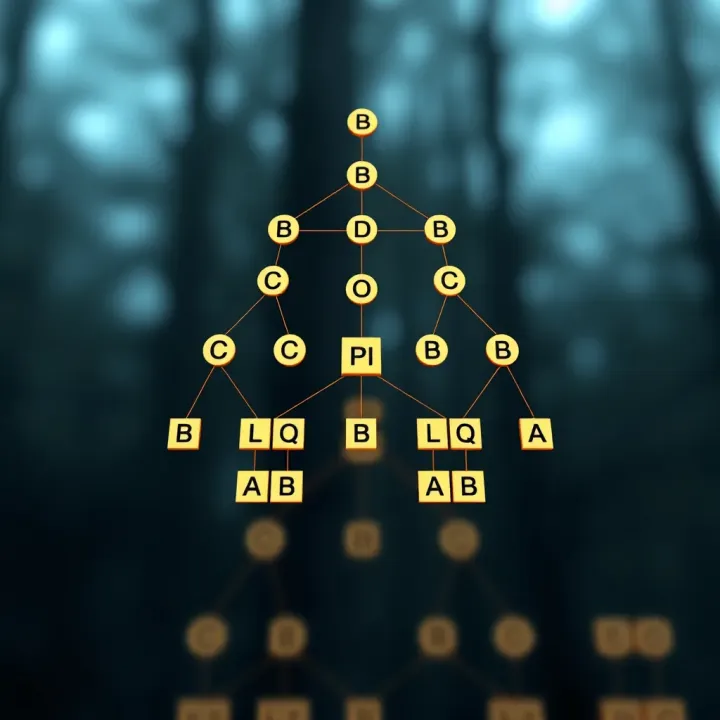
The left child node’s key must always be less than its parent’s key, and the right child node’s key must be greater. This rule applies recursively down the tree, maintaining sorted order at every level. Ignoring this rule breaks the BST property, leading to inefficient searches.
Imagine inserting new stock values one by one. Each time you compare the new value with the current node's key to decide left or right placement. For instance, inserting Rs 500 into a BST node with key Rs 600 will put Rs 500 on the left subtree. Following this consistently ensures your final tree supports fast searches by quickly narrowing down possible key locations.
Remember, understanding these core structural rules forms the foundation for implementing and using BSTs efficiently in financial software, trading algorithms, or any scenario requiring ordered data management.
Implementing a Binary Search Tree (BST) in Python is a practical step towards understanding how this data structure works in real-world scenarios. For traders, investors, and crypto enthusiasts, BSTs can help organise and search through data efficiently—think of tracking stock prices or crypto transactions where quick lookups matter. Python’s straightforward syntax allows clear demonstration of BST concepts, making the implementation easier to grasp and apply.
Defining node attributes is the foundation of building any tree structure. In a BST, each node typically holds a key (or value), and references to its left and right child nodes. These attributes let the node store data and link to other nodes, forming the tree’s skeleton. For example, when storing stock prices, each node’s key could be a specific price, while the left and right child nodes would point to prices less than or greater than this key respectively.
Initialising nodes means setting up the node’s attributes when creating a new instance. In Python, this usually involves a constructor (init) that assigns the key and sets the left and right child pointers to None initially. This setup ensures each new node starts as a leaf without children, ready to be attached to the BST during insertion. Proper initialisation avoids errors during tree operations and guarantees the tree maintains its structure.
Initialising the BST itself commonly involves creating a class with an attribute to hold the tree’s root node. Initially, this root is None, indicating the tree is empty. This setup allows incremental building of the BST—nodes get inserted one by one, growing the tree. For active traders, this structure could model a live dataset where new price points are added continuously, and fast retrieval is key.
Methods for insertion and searching form the core of BST functionality. The insertion method places new nodes according to BST rules, ensuring left children have smaller keys and right children have larger keys. This keeps the tree ordered and enables quick lookups. The search method exploits this order by comparing keys at each node, deciding to move left or right, which results in faster searches than scanning a list. Traders analysing large sets of market data will benefit from these methods, as they allow swift identification of price points or transaction details without scanning everything.
A well-implemented BST in Python can dramatically improve data handling efficiency, crucial in fast-paced financial environments where decision speed counts.
By focusing on these class structures and methods, you can build a solid BST that suits applications from portfolio analysis to crypto transaction tracking, balancing simplicity with performance.
Understanding common operations on binary search trees (BST) is fundamental for anyone working with this data structure. These operations - inserting, searching, and traversing - directly affect how efficiently data can be managed and retrieved, especially in applications like stock market analysis or cryptocurrency portfolio management where quick searches and updates are routine.
Recursive insertion method works by starting at the root node and comparing the value to be inserted with the current node’s key. If the value is smaller, it moves left; if larger, it moves right. This continues recursively until it finds an empty spot to insert the new node. This method simplifies code and naturally respects the BST property. For example, when adding stock prices dynamically to a BST for quick retrieval, recursion ensures that prices are stored correctly without manual traversal.
Handling duplicates in BSTs requires a clear strategy because inserting identical values can break the tree’s structure or cause confusion during search. One common method is to reject duplicates outright, useful in cases like unique transaction IDs where duplicates make no sense. Alternatively, duplicates can be stored in a list at the node or consistently placed either in the left or right subtree. This decision impacts how balanced and efficient the tree remains, especially when large datasets include repeating values such as cryptocurrency transaction timestamps.
The search logic uses the BST’s ordering property to narrow down the location of a desired value. Starting at the root, the algorithm compares the sought value with the current node’s key and moves left or right depending on whether it’s smaller or larger. This targeted approach reduces search time significantly compared to linear scans, which is vital when dealing with massive data sets like historical stock prices or token holdings.
When considering performance, it is critical to understand that BST search operations generally have average time complexity of O(log n) if the tree is well-balanced. However, in worst cases like a skewed tree, it can degrade to O(n). This affects data retrieval speed, so maintaining balance or using self-balancing trees could be important for continuous trading platforms or real-time analysis tools.
Inorder traversal visits nodes in ascending order: left subtree, current node, then right subtree. This is particularly useful for retrieving financial data sorted by key, such as listing stocks by price or date. It produces a sorted list with minimal effort, saving time when compared to manual sorting after retrieval.
Preorder traversal processes the current node first, then visits left and right subtrees. This traversal helps in scenarios where the structure of details matters more than sorted data — for instance, when recreating or copying the BST structure for backup or transmission to another system.
Postorder traversal visits both subtrees first and then processes the current node. It’s useful in cases like deleting the entire tree or freeing up memory because it ensures children nodes are handled before their parent, avoiding dangling references or errors during cleanup.
Mastering these operations ensures efficient data handling in your Python BSTs, which is indispensable for traders and analysts dealing with rapid data updates and queries.
Working with binary search trees (BST) involves more than just adding and searching nodes. Handling special cases like deletion and improving the tree’s structure through balancing are essential for maintaining efficiency and reliability. These steps help prevent performance drops and ensure the BST remains useful for real-world applications such as data indexing or financial analytics.
Deleting leaf nodes is the simplest case of node removal. Leaf nodes have no children, so removing them doesn't affect the rest of the tree structure. For example, if a stock symbol stored as a leaf node in a trading system is no longer relevant, it can be safely removed without extra adjustments. This operation mainly involves updating the parent’s pointer to null, making it straightforward and efficient.
Deleting nodes with one child requires a bit more care. When a node to be deleted has either a left or right child, that child replaces the node. This keeps the BST properties intact without losing any parts of the tree. Imagine removing an outdated price level from an order book tree where it has only one subordinate level; the child node fills the gap directly.
Deleting nodes with two children is the trickiest scenario. To maintain BST order, the node’s key must be replaced by either the smallest key in its right subtree (inorder successor) or the largest in its left subtree (inorder predecessor). Then, that successor or predecessor is deleted. This strategy keeps the tree ordered and balanced after deletion. For instance, if an investor’s portfolio BST stores assets and one asset gets sold (deleted), replacing it correctly maintains the portfolio’s order for quick searches.
Issues with unbalanced BSTs arise when the tree becomes skewed—either left or right heavy. This situation turns the BST into a structure similar to a linked list, causing operations like search, insert, and delete to degrade to linear time (O(n)). In financial systems, this means slower queries on large datasets, such as stock prices or transaction histories, affecting decision-making speed.
Basic techniques for balancing include rotations and self-balancing variants like AVL or Red-Black trees. Rotations adjust the tree structure locally to reduce height without violating BST rules. These methods prevent the tree from becoming overly skewed. For example, balancing is crucial in crypto trading platforms handling rapid insertions of transaction data, ensuring that queries remain fast even as the dataset expands.
Maintaining balance and properly handling node deletion help BSTs stay efficient and reliable, which is vital in contexts like stock trading where data retrieval speed matters a lot.
By understanding and implementing these special cases and enhancements, you ensure your BST not only works correctly but also performs well under pressure.
Practical examples offer the best way to understand how binary search trees (BST) operate in real scenarios. When you code a BST in Python, you are not just seeing theory but making the algorithm perform actual data operations. This hands-on approach is especially helpful for traders, investors, and analysts looking to implement efficient data structures in their financial models.
Writing example code for insertion and traversal is essential to grasp how BST nodes are added and accessed. Inserting values in the BST follows its properties: smaller values go left, larger ones go right. Traversal methods like inorder, preorder, and postorder help you retrieve data in different sequences—vital for sorting or analysing datasets. For instance, inorder traversal visits nodes in ascending order, which can be used to sort stock prices efficiently.
Testing searches and deletions is equally important since it highlights how BST manages dynamic data. Search operations are fast due to BST's ordered nature, valuable when you want to quickly find a specific stock’s performance or cryptocurrency value. Deleting nodes, especially those with two children, involves rearranging the tree to preserve its properties. Practising these operations helps avoid errors in live models where data changes frequently.
BSTs play a significant role in searching and sorting tasks common in financial applications. Searching within large datasets—like company financials or market trends—is faster due to the BST's logarithmic time complexity on average. Sorting information such as transaction timestamps or stock prices becomes straightforward with BST traversal methods, making analyses more efficient.
The advantages of BST in data organisation extend beyond speed. BSTs use memory efficiently by storing data in nodes connected by pointers, and their structure allows incremental updates without reprocessing entire datasets. This flexibility suits real-time trading systems where new information constantly arrives. Also, BSTs can adapt to various data sizes, from small portfolios to extensive market data, providing a scalable solution.
By practising with Python examples of BSTs, you prepare yourself to handle large financial datasets efficiently, improving decision-making and operational speed in trading and investment scenarios.
Overall, practical BST coding sharpens your ability to manage data-intensive tasks common in finance, making your software tools more capable and reliable.
📘 Learn how to master binary search in Python with clear explanations, iterative & recursive methods, performance tips, and practical coding examples.
Understand binary search trees (BST) in detail 🌳: their structure, insertion, searching, and practical programming uses for efficient data handling in computer science.

🔍 Learn how the binary search algorithm swiftly locates items in sorted data structures. Explore its mechanics, coding tips, and real-world uses.

🔍 Explore how binary search efficiently finds elements in sorted lists, its step-by-step working, implementation tips, and why it outperforms simple search methods.
Based on 5 reviews