

Understanding Binary Division: Key Concepts Explained
Explore clear explanations & step-by-step methods for binary division 🧮. Perfect for students & pros in Pakistan aiming to master binary arithmetic efficiently.
Edited By
Amelia Turner
A binary search tree (BST) is a type of data structure widely used in computer science to organise and manage data efficiently. Think of it as a sorted family tree, where each node holds a value, and every branching follows a strict order. This order ensures quicker search, insertion, and deletion operations compared to unsorted structures.
At its core, a BST is a binary tree where each node has at most two children: the left and right child. The defining property is that for any node:
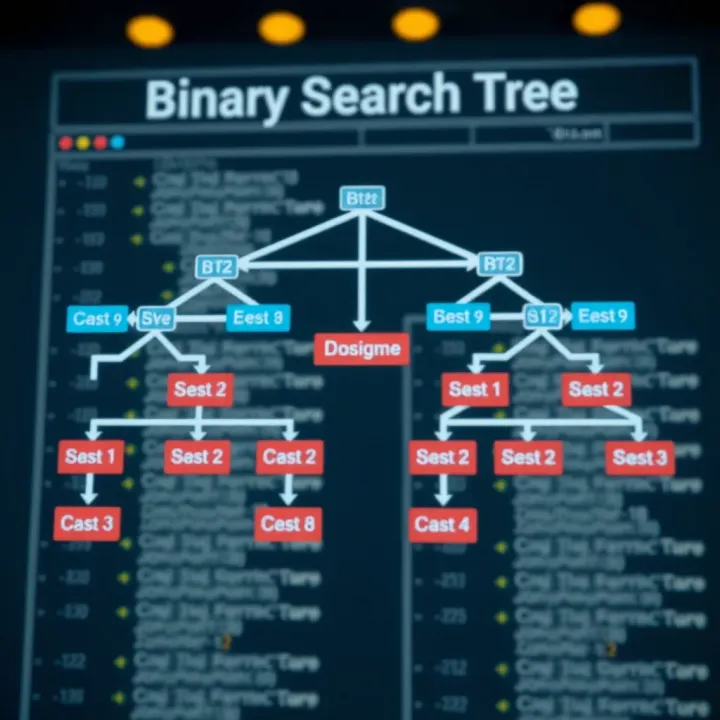
All values in the left subtree are less than the node’s value.
All values in the right subtree are greater than the node’s value.
This sorting rule enables operations like searching for a value to traverse the tree plausibly in logarithmic time, assuming the tree is balanced. This is much faster than scanning through an unsorted list.
For example, if you are managing a dynamically changing list of stock prices or cryptocurrency values, a BST can store these numbers with quick access to any value. When retrieving data like the highest or lowest price in a range or inserting a new price point for fast analytics, BSTs become useful.
Efficient lookup in a BST depends largely on how balanced the tree remains during operations. An unbalanced tree might degrade performance, resembling a simple linked list.
Fast Searching: Finds whether a value exists in about log n steps.
Efficient Insertions: Adds new nodes without rearranging the entire structure.
Ordered Traversal: Can retrieve data in sorted order with an in-order traversal.
Understanding the structure and behaviour of BSTs helps programmers implement efficient data handling especially in applications requiring frequent lookups, like trading systems or portfolio management tools. It sets the foundation for more complex tree structures used in databases and file systems, where speed and order are crucial.
Next, we will explore how insertion and searching work in BSTs with simple examples reflecting common programming scenarios.
Understanding what a binary search tree (BST) is forms the foundation for grasping its practical utility in computer programming and data management. A BST organises data efficiently, making operations like search, insertion, and deletion faster than in unsorted structures. This matters a great deal for anyone dealing with large datasets or systems requiring quick retrieval times, such as stockbrokers monitoring real-time trade data or crypto enthusiasts analysing coin transactions.
A binary search tree is a type of binary tree where each node holds a value, and nodes are arranged with specific ordering rules. Every node can have up to two children: a left child and a right child. The defining characteristic is that for any node, all values in its left subtree are less than the node's value, and all values in its right subtree are greater. This strict ordering allows the BST to quickly skip large parts of data when searching.
Consider a simple example: if you're looking for the price of a particular stock in a BST of stock prices, the tree structure lets you jump to the correct half of data repeatedly until you find the desired value or confirm its absence. This makes BSTs much more efficient than common linear searches, especially as data grows.
Besides, BSTs tend to be dynamic by nature; you can add or remove nodes without restructuring the entire tree. This flexibility benefits software managing changing financial portfolios or live market data streams.
Each node in a binary search tree contains three key components:
Value: The actual data, such as a stock price or cryptocurrency transaction ID.
Left Child Pointer: A reference to the node’s left child, representing smaller values.
Right Child Pointer: A reference to the node’s right child, representing larger values.
Nodes are linked to form a hierarchical structure. The topmost node is called the root. From there, every other node descends, maintaining the order property.
This organisation means the BST resembles a decision tree, where each comparison guides you to the left or right subtree. For example, in an application managing investors' portfolios, nodes could represent different securities sorted by their unique identifiers, allowing rapid access and updates.
A well-maintained BST rarely scans the entire dataset, making operations typically faster than linear data structures. This advantage is invaluable in time-sensitive financial systems.
In summary, a binary search tree combines the simplicity of a binary tree with rules that ensure efficient data organisation. This makes it a practical choice for programmers working on financial software, trading platforms, and other applications where quick data access is necessary.

A binary search tree (BST) relies heavily on its key properties to maintain efficient data organisation and quick access. These properties are what make BSTs popular for financial applications like stock price tracking or crypto portfolio management, where rapid searching and updating are essential.
The fundamental property of a BST is the ordering principle: for any given node, all values in its left subtree are smaller, and all values in its right subtree are larger. This creates a sorted structure within the tree, allowing quicker searches compared to unordered structures.
Consider a portfolio where stock ticker symbols are stored in a BST alphabetically. When you search for "TRG" shares, the BST makes it easy to decide whether to check the left or right subtree at each step, cutting down search time. This sorting principle ensures that operations such as searching, inserting, or deleting a value happen in, on average, O(log n) time where n is the number of nodes.
This ordering neatly organises data, reducing the need to scan every element, which is a major advantage over simple lists or arrays for large datasets.
While the ordering principle sets BSTs apart, handling duplicate values requires careful thought. Since BSTs depend on the order for efficient operations, duplicates can complicate the structure.
Common approaches in financial data systems include:
Allowing duplicates only in the right subtree: for example, if you have multiple transactions with the same stock price, the algorithm inserts duplicates to the right, maintaining order without ambiguity.
Storing a count or list at the node: rather than inserting duplicates as separate nodes, the BST node maintains a counter or a list of all identical values, saving space and speeding up updates.
For instance, a crypto exchange might see multiple trades at the same price point. Rather than cluttering the BST with repeated nodes, handling duplicates efficiently avoids unnecessary tree growth.
Design choices depend on specific needs, but addressing duplicates is vital to keep BSTs performant and reliable in real-world financial applications.
Overall, these properties form the backbone of BSTs. Understanding and correctly applying them is key to making the most of BSTs in data-heavy environments like trading firms, analytics companies, or any system dealing with large volumes of ordered data.
Understanding the core operations on binary search trees (BSTs) is essential for grasping how these structures manage data efficiently. The primary actions— insertion, searching, and deletion— determine the performance and integrity of the tree. For investors and traders working with complex datasets, optimising these operations can translate to quicker data retrieval and better decision-making.
Insertion adds a new value into the BST while preserving the fundamental ordering principle: left child nodes hold smaller values, and right child nodes hold larger values. Starting at the root, the algorithm compares the new element with current nodes, moving left if it's smaller or right if larger, until it finds a suitable empty spot. For example, inserting Rs 5 lakh into a BST tracking investment amounts involves traversing from the root node down to the appropriate leaf node based on comparisons.
This operation is straightforward but must be handled carefully to maintain tree balance. Left unchecked, repeated insertions on sorted data can degrade the BST to a linked list, causing inefficiency.
Searching in a BST benefits from its sorted nature. To find a specific value—say, a particular stock price—one starts at the root and moves left or right depending on whether the target is smaller or larger than the current node. This approach reduces the average search time significantly compared to unsorted arrays.
For instance, a trader looking for the price of a commodity on a specific date could use a BST where each node represents the date and price, enabling rapid lookup without scanning the entire dataset.
Deletion is trickier because removing a node can disrupt the BST’s structure. There are three scenarios:
Leaf node: Simply remove the node.
Node with one child: Replace the node with its child.
Node with two children: Replace the node’s value with its in-order successor (smallest value in the right subtree) and delete that successor.
Proper deletion ensures the BST remains valid for future operations.
Balancing the tree prevents it from becoming skewed, which can happen after many insertions or deletions. Balanced BSTs, like AVL or Red-Black trees, automatically adjust structure to keep operations efficient. For financial data, where updates and queries are frequent, maintaining balance ensures speed isn’t sacrificed over time.
Efficient insertion, searching, and deletion keep BSTs practical for real-world data tasks. Traders relying on quick data access should consider BST implementations that handle balancing internally to maintain consistent performance.
Binary Search Trees (BSTs) have practical importance in software engineering and financial systems. They provide a balance between simple data storage and efficient data retrieval, which is especially relevant for traders and analysts working with large, dynamic datasets.
BSTs feature prominently in database indexing, which helps speed up search queries in trading databases or stock exchange logs. For example, when you want to quickly find a specific stock’s price record or transaction history, BSTs help narrow down the search within milliseconds compared to linear data searches. This becomes critical during market hours when decisions need to be instant.
In software development, BSTs underpin various algorithms that require sorted data management. Consider trading platforms that maintain live order books where insertion, modification, or cancellation happens frequently. BSTs maintain an ordered structure that allows these operations to occur swiftly, avoiding delays that could cost money in volatile markets.
BSTs also support range queries efficiently. If an investor wants to scan all stock prices between Rs 100 and Rs 200, a BST can traverse the tree part that holds this range, rather than checking every single record.
BSTs combine the simplicity of linked data structures with faster search times than an unordered list. Unlike arrays that may need resizing or linear searches, BSTs dynamically adjust as data is added or removed without extra space.
Compared to hash tables, BSTs keep data sorted, which allows in-order traversal to report sorted values naturally. Hash tables might struggle here, as they do not maintain order inherently.
Moreover, BSTs offer better worst-case performance for ordered operations. For example, for reporting the top 10 gains in a trading day, a balanced BST traverses only part of the tree, saving time compared to scanning a full dataset.
Balanced BSTs maintain a height close to log(n), which keeps insertion, searching, and deletion operations efficient even as data grows—vital for managing portfolios with thousands of stock entries.
In summary, BSTs are valuable tools for financial software due to their balance of speed, ordered data access, and adaptability. Traders and analysts can rely on BST-based systems to crunch large datasets quickly, providing an edge in timing-critical decisions.
Binary Search Trees (BSTs) are fundamental for efficient data management in many financial and trading applications. Given their frequent use in search and sort operations, implementing BSTs correctly can significantly affect system performance. This section shares practical tips that help you avoid common pitfalls and improve the efficiency of your BST implementations.
One frequent challenge is handling unbalanced trees. When nodes are added in a sorted order, BSTs can degenerate into linked lists, causing search times to spike from O(log n) to O(n). Take the example of inserting stock prices that increase steadily; the BST could become skewed, slowing down searches for specific price points.
To avoid this, consider using self-balancing BSTs like AVL or Red-Black Trees. These maintain height balance automatically, ensuring consistent logarithmic search times. While they add implementation complexity, the trade-off pays off in faster data retrieval, which is critical for real-time trading systems.
Another hurdle is managing duplicate values. In financial datasets, you often encounter repeated values, such as identical transaction amounts. Decide early whether duplicates go to the left or right subtree or store a count within the node to keep your tree consistent and search operations predictable.
Memory consumption also poses a challenge, especially with large datasets such as historical price data spanning years. Use pointers efficiently and avoid unnecessary node duplication. Implementing lazy deletion or periodic tree pruning can curb memory bloat without compromising data integrity.
Performance hinges on how well you maintain the BST's balance and manage tree operations. Start by profiling your use cases: if your reads far exceed writes, a standard BST or even a splay tree might suffice. However, if writes happen frequently, an AVL or Red-Black Tree usually fares better.
Implementing iterative methods instead of recursion can reduce function call overhead—helpful when dealing with deep trees. For instance, when searching for a particular stock symbol, iterative traversal can speed up response times.
Caching recently accessed nodes can optimise repeated queries common in trading algorithms. Also, if your application allows, consider batch processing insertions to rebalance the tree less often.
Finally, document your implementation choices clearly. In a team setting, knowing why you chose a particular approach—be it for balancing, duplicate handling, or memory management—prevents confusion and encourages more maintainable code.
Efficient BST implementation isn’t just about correct code; it’s about considering your specific data patterns and usage to build a responsive system.
Applying these tips lets your BST handle the demands of volatile markets and large datasets with better performance, making your financial or trading software more robust and reliable.
Explore clear explanations & step-by-step methods for binary division 🧮. Perfect for students & pros in Pakistan aiming to master binary arithmetic efficiently.

Explore binary code basics, its role in computing 💻, history, and why this system is vital for today's digital tech 🔢.

🔍 Learn binary search with a practical example! Understand its workings, requirements, pros, and cons plus tips for efficient coding in real-world scenarios.

📚 Explore binary search in data structures: efficient searching in sorted lists, how it works, variations, pros, cons, and real-world applications explained.
Based on 8 reviews