

Understanding Binary: Basics and Uses Explained
Explore binary code basics, its role in computing 💻, history, and why this system is vital for today's digital tech 🔢.
Edited By
Isabella Clark
A binary tree is a fundamental data structure in computer science, widely used in programming and data processing tasks. It consists of nodes, where each node has at most two child nodes typically called the left and right child. This simple arrangement forms a hierarchical structure that supports efficient organization and retrieval of data.
Binary trees are different from simple linked lists because of their branching nature. Instead of a linear sequence, each node splits into two paths, allowing more flexible ways to store information. For traders and financial analysts working with hierarchical data like stock prices over time or portfolio structures, understanding binary trees helps organise data efficiently.
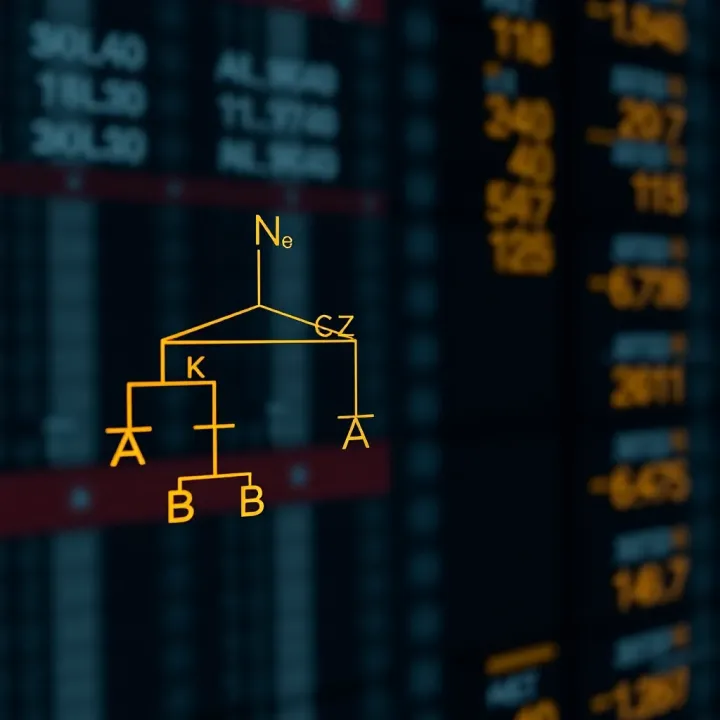
Root node: The top node with no parent.
Leaf node: A node with no children.
Height: The longest path from root to leaf, indicating how deep the tree goes.
These properties influence how fast you can access or modify data in a tree.
There are several types, each serving different needs:
Full Binary Tree: Every node has either zero or two children.
Complete Binary Tree: All levels except possibly the last are fully filled; nodes are as left as possible.
Perfect Binary Tree: A complete binary tree where all leaves are at the same depth.
Understanding operations like insertion, deletion, traversal, and searching is crucial. For example:
Traversal means visiting nodes in an order, such as Inorder (left, root, right) which returns sorted data if the tree holds sorted values.
Searching in a Binary Search Tree variant can quickly find a value by comparing it with node keys, much faster than scanning a list.
Efficient data handling using binary trees reduces processing time, essential for real-time decisions in trading platforms or crypto exchanges where milliseconds matter.
By grasping the basics of binary trees, investors and analysts can appreciate how complex data models are built and manipulated, leading to better insights and faster computational tasks in financial software.
Understanding the structure of a binary tree is fundamental for anyone dealing with data organisation or algorithms. Binary trees form the backbone of many computing applications, from efficient searching to decision-making processes. For traders and financial analysts, grasping this concept can demystify how data flows in tree-based models like decision trees used in market predictions.
A node is the basic unit of any tree structure. Each node holds data and links to other nodes, acting like a box containing useful information and directions. For example, in stock market data analysis, a node could represent a specific stock’s price at a point in time, with further nodes branching out to represent related price movements or trade volumes.
The practical relevance comes when you need to organise complex data hierarchically, like categorising assets by sectors or industries. The node system allows this layered classification, making it easy to navigate and extract valuable insights.
The parent-child relationship defines how nodes connect. Every node (except root) has a parent, and it may have one or two children in the case of binary trees. This hierarchy ensures a clear path from general to specific information—much like how a company’s financial report might break down overall revenue into department-wise earnings.
This relationship helps in navigating the data quickly. For example, moving from a parent node to its child nodes can represent drilling down from a general market trend to individual stock behaviours, aiding quicker decision making.

A binary tree is a tree data structure where each node connects to at most two other nodes, called children. Unlike other trees that might have many children per node, a binary tree sticks to two, which simplifies operations and improves efficiency.
This is practical because it reduces complexity without losing the ability to represent hierarchical relationships. In financial algorithms, this simplification can speed up processes like searching or sorting market data.
Limiting each node to two children brings balance and predictability to the tree's growth. For instance, in a trading algorithm, the left child node might store data reflecting a price drop, and the right child data representing a price rise, making the structure intuitive.
Having a maximum of two children helps maintain simpler traversal paths, which is valuable when rapid data processing is essential, such as in high-frequency trading environments.
The root node is the starting point of the tree—like the opening statement in a financial analysis report. Leaf nodes sit at the bottom with no children; they represent final data points, such as individual trade outcomes. Internal nodes lie between, connecting the root to leaf nodes, holding intermediate data.
Understanding these types of nodes aids in visualising data flow. For example, a decision tree analysis used by a stockbroker might start with an overall market condition (root), branch through various indicators (internal nodes), and end with specific buy or sell recommendations (leaf nodes).
Recognising the structure of a binary tree helps you model data logically and perform operations more efficiently, which proves handy in fast-paced environments like trading floors.
Nodes store data and act as connection points.
Parent-child links define data hierarchy.
Binary trees limit children to two for simplicity.
Root, internal, and leaf nodes represent different data levels.
Getting comfortable with these concepts lays a solid foundation for exploring more advanced tree types and operations, which are vital tools in financial data analysis and computer science alike.
Understanding the different types of binary trees is essential for grasping their practical uses and limitations in computing. Each type brings its own structure that suits certain operations better, affecting how data is stored, accessed, and managed efficiently. For traders and analysts dealing with large datasets or algorithmic strategies, knowing these distinctions can help optimise performance and resource use.
A full binary tree is one where every node has either zero or two children. This means no node has just one child, keeping the tree structured and predictable. For instance, in financial modelling software, employing a full binary tree ensures that computations proceed uniformly, which is helpful when evaluating paired decisions or conditions.
Complete binary trees fill every level, except possibly the last, from left to right without gaps. This feature makes them highly efficient for heap implementations, often used in priority queues. Such structures are useful when managing task scheduling algorithms or resources where speed and balanced organisation are necessary.
A perfect binary tree is the most symmetric type: all non-leaf nodes have exactly two children, and all leaves are at the same depth. This balance guarantees the minimum possible height for a given number of nodes, which reduces traversal time. Perfect binary trees appear in scenarios like tournament brackets or decision-making processes, where fairness and uniform depth are required.
Balanced binary trees aim to keep the height difference between left and right subtrees minimal, ensuring operations like search, insertion, and deletion remain quick. Balanced trees such as AVL or Red-Black trees prevent performance bottlenecks when handling large, dynamic datasets—crucial in stock market analysis or crypto trading platforms where milliseconds matter.
On the other hand, left or right skewed trees are essentially like linked lists leaning heavily to one side. This happens when data inserts are inherently sorted or unbalanced, causing the tree to degrade. For example, inserting ascending transaction IDs without balancing will create a right-skewed tree, which slows down searches and updates drastically.
Skewed trees often result in linear-time operations, negating the benefits of using tree structures. Maintaining balance ensures more predictable, fast access.
The impact on performance is substantial. While balanced trees typically offer O(log n) complexity for key operations, skewed trees degrade to O(n), directly affecting the speed and responsiveness of applications handling real-time data processing or financial computations. Traders relying on quick look-ups or automated decisions must prefer balanced tree structures to reduce delays.
By recognising these types and features, developers and analysts can make smarter choices in structuring binary trees that fit their specific needs, whether it is for database indexing, risk evaluation algorithms, or fast portfolio querying.
Binary trees become effective when we can perform essential operations on them efficiently. These operations let you explore, modify, and manage the tree to suit various applications like data search, expression parsing, and decision algorithms. Understanding these common operations helps in structuring data better, which is particularly valuable for developers and analysts working with hierarchical information or coding algorithms.
Traversal refers to visiting each node in a binary tree systematically. It helps with reading, searching, or manipulating data stored in a tree structure. There are three main traversal methods each serving distinct purposes.
In-order Traversal visits nodes in a left-root-right sequence. For example, if you have a binary search tree representing stock prices, this traversal will list prices in ascending order. This is useful when sorting data or when you want to retrieve items in a naturally ordered way.
Pre-order Traversal follows a root-left-right order. It is often used to copy trees or evaluate prefix expressions. In practical scenarios, like evaluating an algorithm’s decision-making process, pre-order traversal reveals the structure of the process itself before examining decisions in detail.
Post-order Traversal goes left-right-root and is ideal for deleting trees or evaluating postfix expressions. This method ensures children nodes are processed before their parent, useful in backtracking algorithms or when cleaning up resources in applications.
Traversals shape how we interact with tree data and are the backbone of many tree-related algorithms.
Adding nodes to a binary tree must maintain its structure while placing the new data correctly. Usually, insertion follows rules such as placing smaller values to the left and larger ones right in binary search trees. For instance, inserting a new stock price in a portfolio tracker should preserve the order for quick search and sorting.
Removing nodes can be trickier as it may involve rearranging the tree. Deleting a leaf node is simple, but removing an internal node requires care to preserve the binary tree properties. For example, deleting an outdated financial record from a database must be handled so the search efficiency remains intact.
Maintaining tree structure after insertions or deletions is critical to avoid imbalanced or skewed trees, which slow down operations. Techniques such as rotations in balanced binary trees (like AVL or Red-Black trees) help keep the height small, ensuring operations like search and insertion run efficiently even with large data sets.
Operational efficiency in binary trees directly affects system performance—be it database query speed, trading algorithms, or real-time data processing in Pakistan’s fast-growing tech sector.
Binary trees find multiple uses in computing, especially when organising data or making decisions efficiently. Their structure enables quicker processing and clearer data representation, which is key for performance-focused applications like trading algorithms or financial data analysis.
Binary search trees (BSTs) arrange data in a way that speeds up searching. Each node in a BST has up to two children — one for values less than it, another for greater values. This orderly setup allows speedy lookups, insertions, or deletions without scanning the entire dataset. For example, in stock trading systems, BSTs help quickly access price data or orders, reducing lag during fast market changes.
Thanks to BSTs, searching for a specific data point often takes roughly log2 of the total number of nodes, making it far more efficient than scanning through unsorted lists. This improves the responsiveness of applications such as investment platforms where populating and updating live prices rapidly is crucial.
Efficient lookup operations rely heavily on this sorted tree structure. Unlike simple arrays or lists, binary trees prevent unnecessary comparisons and data scanning. When combined with balancing techniques, like AVL or Red-Black trees, the system ensures operations remain efficient even after many inserts and deletes.
For instance, a crypto exchange tracking wallet balances might use BSTs to update and verify users’ holdings quickly, helping prevent delays during high-traffic hours. This balance between speed and organisation makes binary trees popular in several finance-related software solutions.
Syntax trees in compilers represent the grammatical structure of source code. They break down complex expressions into manageable parts, showing how operations bind in priority too. For software developers, understanding syntax trees clarifies how expressions transform during compilation, improving debugging and optimising code for financial modelling software.
In practice, syntax trees turn a formula like a + b * c into nodes identifying multiplication before addition, respecting rules. This organised parsing is vital for building trading bots or automated investment tools that execute code accurately and reliably.
Decision trees in algorithms simulate choices and possible outcomes, creating a step-by-step flow based on conditions. Traders use decision trees to model various scenarios—say, price movements or risk factors—and decide strategies accordingly.
Such trees map different decisions, including "buy," "hold," or "sell," at branches with probability estimates on market behaviour. Decision trees help make complex financial decisions clearer and allow algorithms to predict outcomes based on current data rapidly.
Binary trees are not just abstract structures — their application in searching, parsing, and decision-making directly supports faster, smarter trading and investment software in Pakistan's dynamic markets.
Explore binary code basics, its role in computing 💻, history, and why this system is vital for today's digital tech 🔢.
Explore complete binary trees 📚, their unique traits, differences from other trees, practical uses in algorithms, and implementation steps for students & pros.

Explore binary operations in math and computer science 🔢. Learn key types, properties like associativity & commutativity, and real-world uses 📊.

Explore the basics of the binary number system 💻, learn how to convert between binary and decimal, and see how binary powers digital tech in daily life 🔢.
Based on 7 reviews